Meet the PhD student: Leonie Chesworth


In the third of series of blogs introducing PhD researchers affiliated with Histories of RGSI, Leonie Chesworth discusses her experience as a public historian, and the surprising link between her undergraduate student accommodation and her current doctoral research.
Can you tell us a bit about yourself and your background?
I am from a town in the West Midlands, where in secondary school I developed a passion for history. This led to my undergraduate studies in History at the University of Huddersfield. It was here that I began to visit more heritage sites and museums, developing an interest in Public History; and so, I continued my studies with an MA in Public History and Heritage at the University of Derby. Alongside my interest in history, I also enjoy going to the theatre to watch musicals and I love playing netball!
In a few sentences, what is your research about?
My research will explore the experiences of deinstitutionalisation within Greater Manchester, looking at how the closures of mental hospitals impacted the patients, the staff, and local communities. Much of the research on mental health focuses on the nineteenth century and my research builds on more recent work in the twentieth century, and offers a regional case study.
What drew you to your research topic?
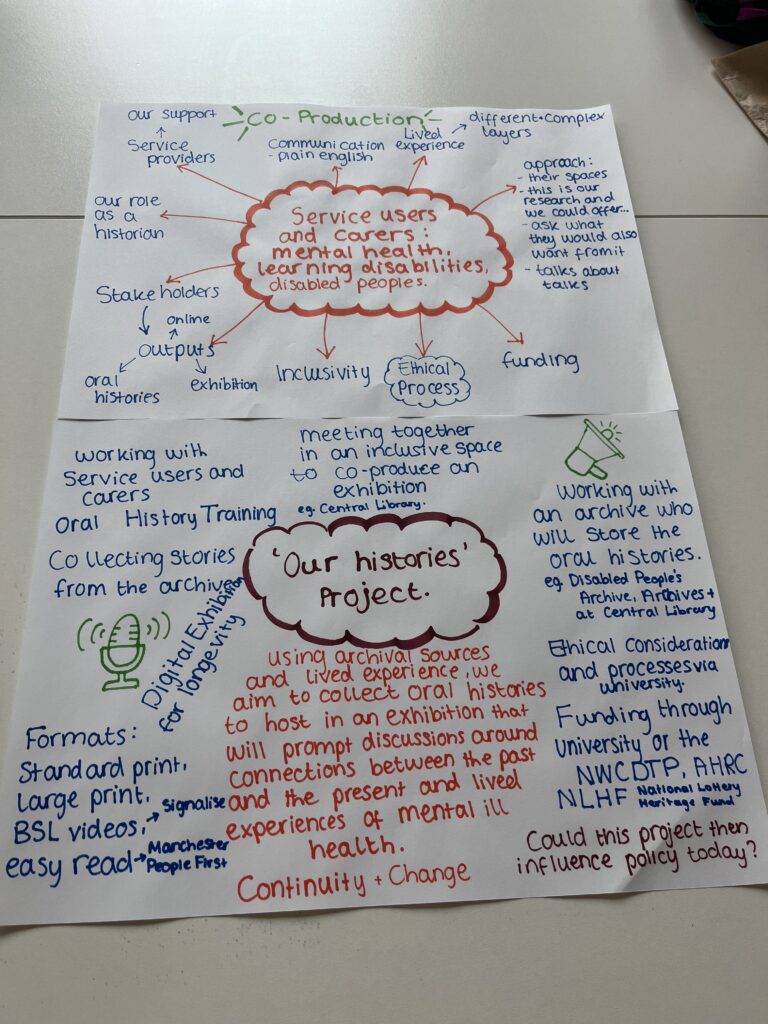
In the final year of my undergraduate studies, I took a module titled ‘Mindsets, Institutions and Madness’ which explored the histories of mental ill health across two hundred years. This module opened my eyes to a very complex picture, with varying experiences throughout history. In addition to this, my student accommodation for my first and second year at Huddersfield was a former mental hospital which had closed in 1991. An oral history project was carried out at this hospital in the 1980s, and I had the opportunity of volunteering for Pennine Heritage where I and another volunteer had digitised this project completed. When digitising the transcripts for this project, I began to understand how the experiences of deinstitutionalisation were varied, and so I wanted to explore these experiences further. It was also during my final year where I took part in a public history project which brought together service users, care staff, students, academics, and heritage professionals to explore the local heritage of Hebden Bridge in a creative and inclusive way. Being involved in this project, I had the opportunity to contribute towards two publications and to see how public history works in practice.
What do you enjoy most about your PhD?
I have not been on the PhD journey for long but so far, I have really enjoyed the challenge of piecing together information. It is incredibly rewarding when you come across a golden piece which fits everything else together!
Why does this history matter today?
Today the country still faces a mental health crisis, and specialists face the question on what to do to support those with mental ill health. Suggested solutions have often reflected structures of the past but due to negative perceptions, these suggestions are often seen as a regression. By researching the experiences of deinstitutionalisation, this research will illuminate the varying experiences and attempt to dismiss some of the stigma which is placed upon the past.
What plans do you have after you complete your doctoral research?
As I am still in the early stages of my PhD journey, I do not have a set in stone plan- and I think it is important to highlight that this is normal. I am looking forward to exploring different paths and building my CV along the way.